
The 3 Key Elements of Manufacturing Website Design (With Examples)
Industrial Manufacturing website design is key for your digital marketing strategies that help grow your revenue. Learn 3 keys to a great website.
There are a lot of machine shops, fabricators, forges, and coating houses out there. If you are a marketing manager at a small to medium sized manufacturing or industrial company, you know how hard it can be to stand out in the sea of competitors. When an engineer or buyer needs a part made, most of them start by looking at websites. They search for a process and a material, open a handful of tabs, and start crossing shops off the list. Many never call the ones they cross off.
That makes your website one of the first and only salespeople a new customer meets with your business. It also means the site has a specific job. It is not there only to introduce you. It is there to help a buyer decide you are worth buying from.
For Dynamic Digital, we’ve worked with industrial and manufacturing companies like yours for over 30 years, constantly helping them increase revenue by having cutting edge digital experiences, powerful websites that portray their capabilities well, and visibility in search engine results and now AI chats.
Across a lot of projects, the sites that bring in steady quote requests tend to get three things right:
- They make it easy for buyers to do their research and buy from you.
- The homepage says clearly what you do and who you do it for.
- They show proof that you can deliver and that they should work with you.
Here is what each one looks like on a real manufacturing website, with examples.
Element 1: Does your website make the buyer's job easier?
Buying a manufactured part or service is a lot of work for the person doing it. Gartner's research on B2B buying breaks the process into six "buying jobs" that customers have to get through:
- Problem identification. What do we need, and why?
- Solution exploration. What processes or suppliers could handle it?
- Requirements building. What exactly do we need (material, tolerance, quantity, timing)?
- Supplier selection. Who makes the shortlist?
- Validation. Can we trust that this shop will actually deliver?
- Consensus creation. Can we get engineering, purchasing, and quality to agree?
Two parts of that research matter most for a shop owner. First, buyers do not go through those steps in a straight line. They loop back. Gartner reports that around 90% of buyers revisit at least one of those jobs along the way. Second, buyers lean on supplier websites about as much as they lean on talking to salespeople when they are discovering options and checking claims. (You can read Gartner's overview of the B2B buying journey if you want the background.)
So the practical question is simple. When an engineer lands on your site with a specific job they have, can they get through those jobs without having to call you first?
What that looks like on a manufacturing website
You need pages that answer the questions a buyer is already asking.
- "Can you make this?" Give each core capability its own page. CNC turning, 5-axis milling, laser cutting, welding, finishing. List the materials you run, typical part sizes, tolerance ranges you hold comfortably, and the quantities you are set up for (prototype, short run, production).
- "Do you work in my industry?" Short industry pages (medical, aerospace, defense, food equipment, energy) help a buyer see themselves in your work. A few sentences and some part photos go a long way.
- "What do you need from me?" Spell out what makes a good RFQ. File types you accept (STEP, IGES, DXF, PDF), the details that speed up a quote, and how long a quote usually takes.
- "Can I make the case to my team?" Make capability and certification pages easy to print or forward. A buyer who has to sell you internally needs something they can paste into an email.
- "How do I reach a person?" Put your phone number in the header and make it tap-to-call on mobile. Plenty of buyers check you on their phone in the plant or between meetings.
And the site has to load fast on a phone. A slow, cramped mobile page is friction before the buyer has read a word.
Example: a contact form vs. a real RFQ form
Hypothetical example for illustration.
Picture two shops with similar equipment.
Shop A has a "Contact Us" page with name, email, and a message box. The buyer types "need a quote on some parts, please call." Now someone at the shop has to call back, find out the material, ask for the drawing, and ask about quantity and due date. Some buyers get a quote elsewhere before that back-and-forth is done.
Shop B has a "Request a Quote" button on every page. The form asks for:
- Material and finish
- Quantity (and whether it is a prototype or a repeat run)
- Needed-by date
- Any certification or documentation requirements
- A file upload for drawings and CAD models
The buyer fills it out once. Shop B's estimator has what they need to start quoting the same day. Shop B did not need a new machine to win that job. It just removed steps for the buyer.
If you want a quick gut check on your own site, our list of signs your site is costing you RFQs walks through the most common gaps.
Element 2: Does your homepage say what you actually do?
Your homepage gets a few seconds to answer a buyer's first question: "Is this the kind of shop I am looking for?" If the answer is not obvious on the first screen, a lot of people hit the back button and try the next result.
The first screen of a manufacturing homepage should tell a buyer four things:
- What you make or do. Name the processes. "CNC turning and milling" says more than "manufacturing solutions."
- Who you do it for. Industries, part types, or the kind of customer you serve best.
- What makes you different. Something specific and true. ITAR registration, tight-tolerance work in exotic alloys, in-house finishing, quick-turn prototypes, a family-owned shop with 40 years on the same floor.
- One clear next step. A single primary button, usually "Request a Quote." A phone number nearby helps.
Your story (why you started, how you work) belongs below the fold. It matters. It just should not come before the basics.
Example: vague vs. clear
Hypothetical example for illustration.
Vague homepage. A big stock photo of a gear, the headline "Precision You Can Trust," and a button that says "Learn More." A buyer has no idea whether this shop turns shafts, stamps brackets, or sells gears. "Precision" and "trust" are words every competitor also uses.
Clear homepage. The headline reads something like "CNC Turning and Fabrication for Medical and Aerospace Parts." Under it, one line: "ISO 9001 and AS9100 certified. ITAR registered. Prototype through production, out of our Pennsylvania shop." A photo of real parts on the shop floor. A "Request a Quote" button and a phone number. A buyer knows in about five seconds whether to keep reading.
Real sites that get this right
When we put together our roundup of real manufacturing website examples, the strongest homepages had this in common.
On Mikron Manufacturing's site, you know they machine and fabricate within the first scroll, and their capabilities are broken out by process.

On Chapel Steel's site (one Dynamic Digital built), the specialty is clear right away: carbon, high-strength, and abrasion-resistant plate, with processing capabilities like cutting, beveling, and forming spelled out.
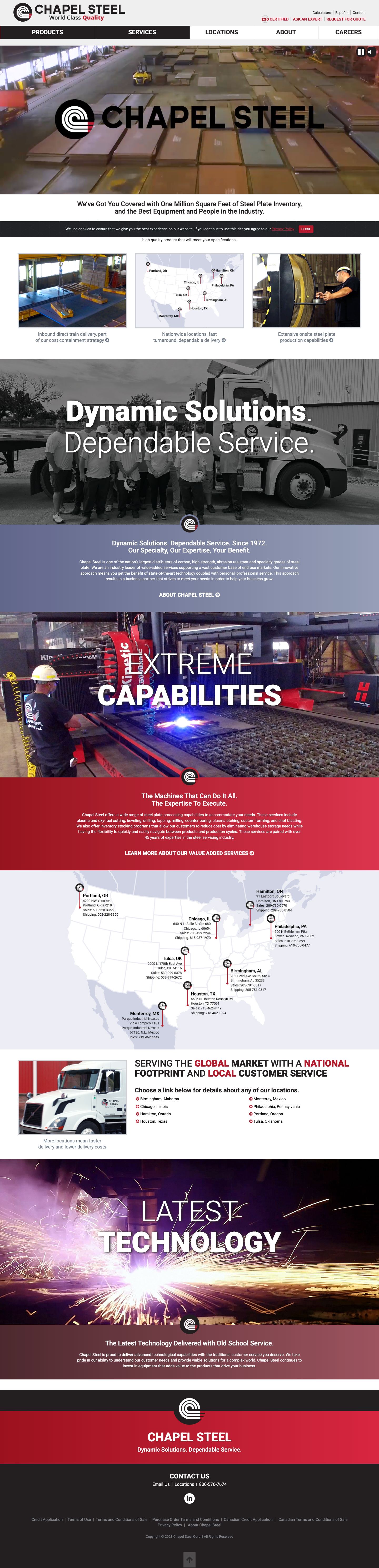
Neither one makes a buyer guess.
Element 3: Does your site prove buyers can trust you?
Once a buyer thinks you might be a fit, they start looking for reasons to believe you. This is the supplier selection and validation part of the process, and it is where a lot of manufacturing websites go quiet. The capabilities are there, but the proof is buried on an About page nobody clicks.
Trust signals that matter to manufacturing buyers
- Certifications. ISO 9001, AS9100, ISO 13485, ITAR registration, NADCAP, or whatever applies to your work. For many buyers, a missing certification is a hard no, so make it easy to spot.
- Real photos of your floor and your parts. Buyers can tell stock photos from the real thing. Your actual machines, your actual people, and finished parts (where customers allow it) say more than any slogan.
- Equipment and capacity details. A short equipment list with machine types, work envelopes, and shifts shows you are set up for the job.
- Short project write-ups. You do not need a long case study. A few paragraphs per project is plenty.
- Google reviews. Buyers and engineers do look, and reviews help with local searches.
- Named testimonials. A quote from a real person, with a name, title, and company (with their permission), carries much more weight than an anonymous line.
Put proof where buyers make decisions
Placement matters as much as content. Put trust signals where buyers are actually shortlisting:
- Certification badges on the homepage and next to the RFQ form, not only in the footer.
- A relevant project or photo on each capability page. A buyer reading about your 5-axis work should see a 5-axis part.
- A short quality section on capability pages that mentions your inspection equipment and certifications.
Example: a simple project summary format
Hypothetical example for illustration.
Here is a format any shop can use, with no invented numbers required:
The problem: A medical device customer needed a supplier for a titanium bone-screw component after their previous shop could not hold the thread tolerance.
The part: Swiss-turned Ti-6Al-4V component with fine threads and a passivated finish, inspected and documented to the customer's requirements.
The outcome: We moved the part from first article to recurring production orders, and the customer has since sent us two related parts.
A buyer reads that in 30 seconds. If you have real numbers you can share (with the customer's OK), add them. If not, the story still works.
How the three elements work together
Each element covers a different moment in the buyer's process. A clear homepage gets a buyer to stay. Capability pages and a real RFQ form make their homework easier. Proof gives them a reason to pick you and something to show their team. When one is missing, buyers drift. When all three are in place, more of the people who find you actually send a drawing.
Most shops do not need to start from scratch to get there. Sometimes it is a homepage rewrite, a better RFQ form, and moving certifications to where people can see them. Sometimes the site really is holding you back and a rebuild makes sense. If you are weighing that, our guide on deciding whether to rebuild can help you sort it out.
If you want a second set of eyes on your site, the Dynamic Digital team in Willow Grove has been building websites for manufacturers since 1994. You can see how we approach a manufacturing website, or just book a 15-minute call and we will walk through your site with you. No pitch deck. Just an honest look at what is helping and what is getting in the way.
Frequently asked questions
What pages does a manufacturing website need?
At minimum: a homepage that names your processes and industries, a page for each core capability, a certifications or quality page, a Request a Quote page with file upload, and an About page with real photos of your shop. Industry pages and short project write-ups are the next most useful additions.
Should a manufacturing website have an RFQ form?
Yes, for most job shops and contract manufacturers. A good RFQ form asks for material, quantity, timing, and requirements, and lets buyers upload drawings or CAD files. That saves both sides several rounds of email before a quote can start.
Where should certifications go on a manufacturing website?
Put them where buyers make decisions: on the homepage, on capability pages, and next to the RFQ form. A dedicated quality page is good too, but it should not be the only place they appear.
Do Google reviews matter for B2B manufacturers?
They can. Buyers and engineers often check reviews when comparing shops, and reviews help with local search. A few honest reviews from real customers or partners are worth asking for.
Ready to talk?
If you're starting from scratch or replacing something that's holding you back from growing, our manufacturing website design work is built for shops like yours to see what we can do. Dynamic Digital is the agency for industrial manufacturing website design in Willow Grove, PA that has been building websites since 1994.
Talk through this with us
If you want help applying these ideas to your team, we are happy to walk through options in a short call.
We’re ready when you are.
Schedule a free 15-minute discovery call.
We'll listen to where you are and share how we can help.